
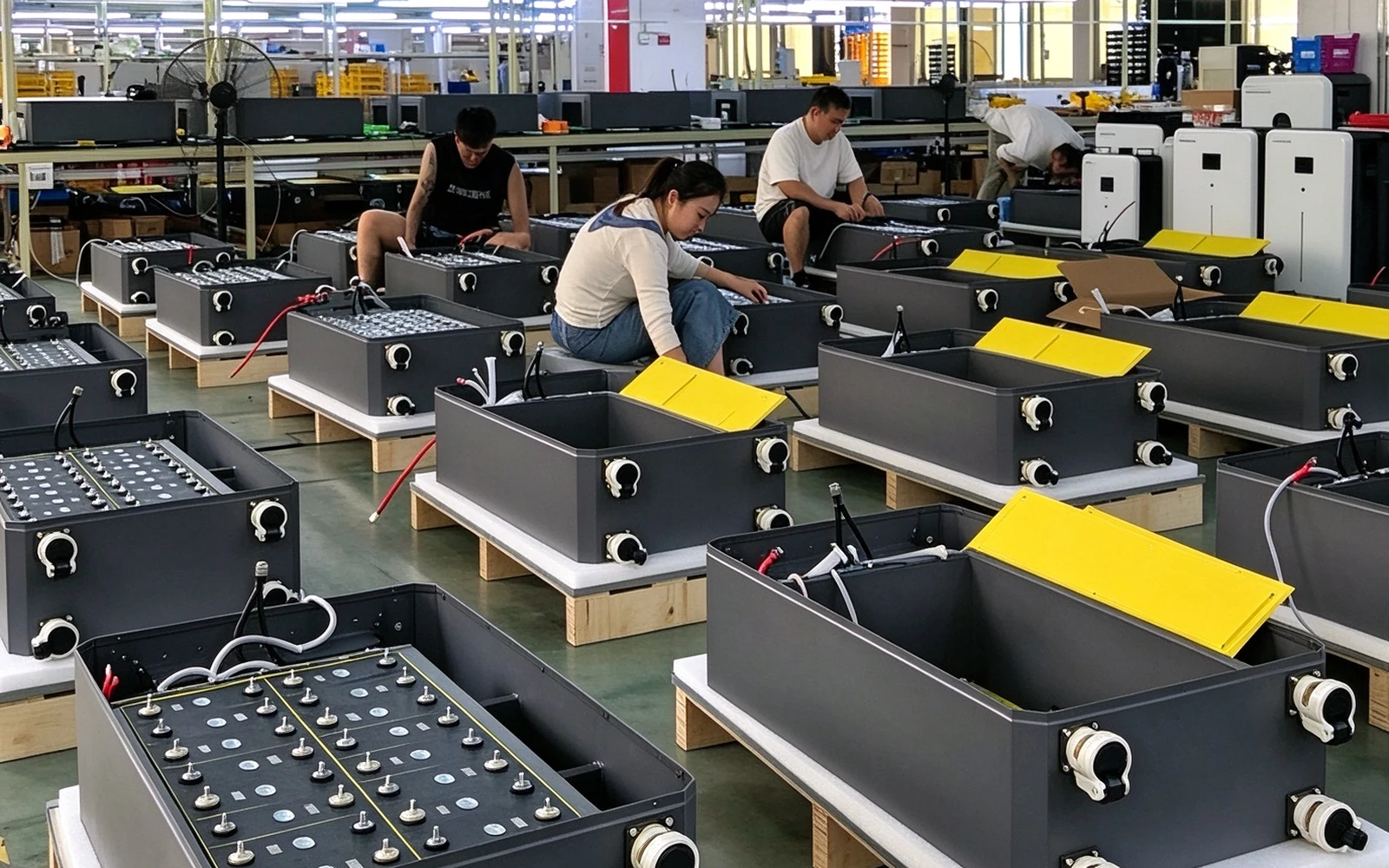
A home battery looks like a sealed box with a sticker on it. Inside, a 5–16 kWh pack is a few hundred prismatic cells, a BMS, a busbar stack and a steel enclosure — and the difference between a pack that still holds 80% at year ten and one that drifts out of balance at year three is decided on the assembly line, not in the datasheet.
This is what actually happens between a cell arriving at our door in Guzhen, Zhongshan and a finished unit rolling onto a pallet.
1. Cells are graded before they are allowed near a pack
Every incoming lot is sampled for capacity, internal resistance and self-discharge. Cells that go into the same pack are matched to within roughly 2% capacity and a narrow resistance window. Mixing grades is the single most common cause of early imbalance — one weak cell drags the whole string down, the BMS cuts off early, and the customer experiences it as “the battery lost capacity”.
2. Module build, with torque you can prove
Cells are seated into modules and the busbars are bolted with a calibrated driver set to spec, then re-checked. At 100 A continuous, a loose busbar is not a small defect: it is a hot joint, a voltage drop and eventually a burnt terminal. Our line records torque per station rather than trusting the operator’s wrist.
3. BMS wiring and insulation test — before the lid closes
The harness is routed and every sense lead is fused so a single shorted wire cannot take out the whole BMS. Insulation resistance is measured while the pack is still open; finding a pinched harness after the enclosure is sealed means rework, and rework is where quality quietly disappears.
4. Every unit is cycled, not sampled
Finished packs go onto the test bench for at least one full charge and discharge. The station logs capacity, cell voltage spread and temperature rise. A 16 kWh unit that delivers 15.2 kWh on the bench is a 16 kWh unit; one that delivers 14.6 kWh is a claim waiting to be disputed in a container yard.
5. Enclosure, ingress protection and the boring parts
Welded sheet steel, powder-coated, with IP20 as standard and IP65 available for outdoor cabinets. Casters are rated for the finished weight with margin — a 16 kWh pack is over 140 kg, and a cheap caster is the first thing to fail in the field.
6. The paper that has to travel with the box
UN38.3 test summary, MSDS, IEC 62619 report and a CE declaration of conformity leave with every shipment. These are not marketing documents: without the UN38.3 summary the forwarder cannot legally load the container, and without the MSDS the shipping line will not accept the booking.
What to ask any supplier, including us
- Can I see a capacity test report for the exact model, not the family?
- What is the cell matching window, in percent capacity?
- Is every unit cycled, or is it batch-sampled?
- Which IEC report number covers this enclosure?
- Who records busbar torque, and can I see the record?
If the answers are vague, the pack is probably assembled to a price. We build 5–16 kWh LiFePO4 home batteries and 300 W – 2500 W portable stations in Guzhen, Zhongshan — request a quote or ask for a video walk-through of the line.
By the Kangjun engineering team · Last updated: 30 October 2026
Related models: 5 kWh KJ-48100-5 · 10 kWh KJ-48200-10 · 16 kWh KJ-16 · Compare all models