
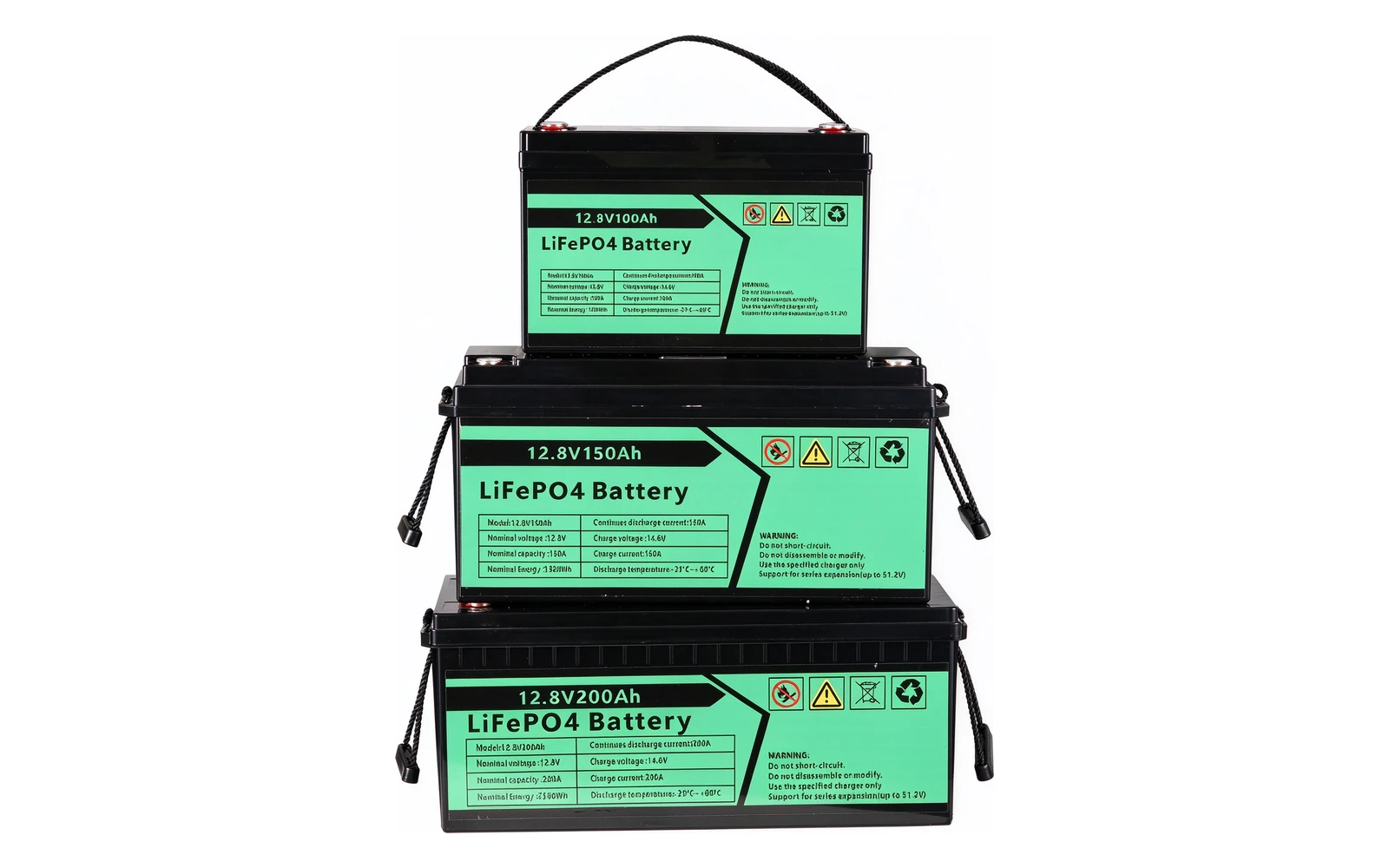
The comparison that matters is not price per battery — it is price per usable kilowatt-hour over ten years
Lead-acid is cheaper on the invoice. It is not cheaper over the life of the system, and the gap widens in year three, when the first bank is already losing capacity while the lithium pack is still in its first third of life.
This is not an argument that lead-acid is useless. It is an argument that the two technologies should be compared on the numbers that actually decide the outcome.
Depth of discharge: the hidden multiplier
A lead-acid bank should not be discharged below about 50% if you want it to last. A LiFePO4 pack runs to 90–95% without damage. So a 100 Ah lead-acid battery gives you roughly 50 Ah of usable energy; a 100 Ah LiFePO4 battery gives you about 90–95 Ah.
Put differently: to get the same usable capacity, you need roughly twice the nameplate capacity in lead-acid. Half the price per nameplate amp-hour becomes close to the same price per usable amp-hour — before cycle life is counted.
Cycle life: where year three shows up
Typical figures for the two chemistries, at moderate depth of discharge and normal temperature:
- Flooded or AGM lead-acid: 300–600 cycles to 50% capacity.
- LiFePO4: 3,000–6,000 cycles to 80% capacity.
A daily-cycling home system does about 365 cycles a year. That puts a lead-acid bank at the end of its useful life in roughly one to two years of hard cycling, and a LiFePO4 pack at eight to fifteen. In year three, the lead-acid bank is being replaced and the lithium pack has lost a few percent of capacity.
What actually degrades first
Lead-acid fails through sulfation — crystals form on the plates when the battery sits partly discharged, and never fully convert back. It is accelerated by shallow charging, high temperature and long periods at low state of charge. That is why a bank that is “always on float” can still die early.
LiFePO4 fails mainly through calendar ageing and cycle wear on the cathode and SEI layer. It does not sulfate. It also does not need equalisation charges, watering, or a monthly full charge to stay healthy — the BMS balances the cells and reports state of charge.
Charging: less babysitting, but not zero rules
Lead-acid needs a three-stage profile — bulk, absorption, float — and the absorption time has to be long enough to finish the charge. Get it wrong and you sulfate the plates or boil off electrolyte.
LiFePO4 is simpler: constant current to the absorption voltage, then hold, then stop. No float maintenance. But there is one rule that is easy to break: do not charge below 0 °C. Charging a lithium pack below freezing plates lithium metal on the anode and permanently reduces capacity. Good BMS units block charging in the cold; cheap ones do not. If the battery lives in an unheated outbuilding, check that the BMS has a low-temperature charge cut-off.
Weight, space, and the installation you did not budget for
LiFePO4 stores roughly three to four times the energy per kilogram of lead-acid. A 10 kWh lead-acid bank weighs in the region of 250–300 kg and needs a ventilated room and a reinforced floor. A 10 kWh LiFePO4 wall unit is around 90–110 kg and hangs on a wall.
That difference shows up in freight, in installation labour and in whether the system fits in the space the customer actually has.
When lead-acid still makes sense
It is not always the wrong choice. Lead-acid wins when:
- the battery is used rarely — a standby bank that cycles a few times a year, where calendar life rather than cycle life dominates;
- the installation is in a very hot climate and the lithium BMS would be working at its temperature limit anyway;
- the budget is fixed and the load is small, and the customer understands the replacement interval;
- the application needs very high short-term current and weight does not matter.
The migration checklist
If you are replacing a lead-acid bank with LiFePO4, four things need checking before the swap:
- Charge voltage. The existing charger or inverter must have a lithium profile, or be adjustable to 3.45–3.65 V per cell (55.2–58.4 V for a 48 V pack).
- Low-temperature behaviour. Confirm the BMS cuts charging below 0 °C, or move the battery indoors.
- Inverter communication. A drop-in replacement may run open-loop; a managed pack needs CAN or RS485 that the inverter understands.
- Cable and fuse sizing. Lithium accepts charge faster and holds a flatter voltage, so currents can be higher than the old bank ever drew.
Our 12.8 V and 51.2 V packs are built as drop-in replacements for exactly this upgrade path — same footprint, same terminals, with the BMS handling the protection the old bank did not have.
By the Kangjun engineering team · Last updated: 30 October 2026
Related models: 5 kWh KJ-48100-5 · 10 kWh KJ-48200-10 · 16 kWh KJ-16 · Compare all models